


Holding the Line: How Prevention Became Military Strategy

Updated: Sep 5
Summary

This week on Infectious Dose, we're exploring one of history's most consequential infectious disease turning points: the moment armies realized that defeating an enemy required preventing disease.
From George Washington's controversial smallpox inoculation order to Florence Nightingale's sanitation reforms, Walter Reed's yellow fever experiments, William Gorgas's mosquito control campaigns, and the rise of modern military vaccination, this episode traces how infectious disease reshaped military strategy. Along the way, we'll connect these historical lessons to more recent outbreaks aboard the USS Theodore Roosevelt and at Lackland Air Force Base, asking what military history can still teach us about preparedness, prevention, and readiness today.
Listen here or scroll down to read full episode.
Also available on all major podcast platforms
Full Episode
When we picture the greatest threats to an army, we think of the obvious ones: enemy soldiers, explosions, fighter jets, tanks, missiles, machine guns. Battles have names. Victories become monuments. Generals become legends.
But for most of human history, armies feared something else just as much—often far more. An enemy no one could see. Long before microbes had names, armies marched into battle carrying invisible passengers: dysentery in crowded camps, smallpox spreading from tent to tent, cholera in contaminated water, malaria in the marshes, typhoid wherever sanitation failed, influenza racing through barracks. Again and again, disease accomplished what opposing armies could not.
One of the most important turning points in infectious disease history came when military leaders finally realized that protecting soldiers from disease was not separate from military readiness. It was military readiness. That realization transformed armies around the world. It led to cleaner camps, safer water, organized sanitation, disease surveillance, vaccination programs, and the birth of modern preventive medicine. Many of the public health practices we now take for granted were refined because militaries learned—sometimes at tremendous cost—that microbes could cripple an army just as effectively as any opposing force.
Centuries later, that lesson remains surprisingly relevant. Right now, an influenza outbreak at a military training base in Texas has sickened hundreds of recruits and presumably claimed the life of one trainee. It is a reminder that the invisible enemy never disappeared. We got better at fighting it—but maintaining those defenses requires constant effort, and history shows that effort isn’t always sustained.
Today, we're exploring one of infectious diseases most consequential turning points: the moment armies realized that the battle against disease was inseparable from the battle itself.
This is Holding the Line: How Prevention Became Military Strategy.
Before the Enemy Arrived
If you could travel back through military history, you would quickly discover that many warring armies were fighting two wars at once. One against the opposing force. The other against the invisible world of infectious disease.
The list of diseases changed depending on the place and the century, but the story remained consistent. Disease was viewed as an unavoidable companion of war—a hardship to be endured rather than a threat that could be systematically controlled.
Military physicians certainly existed, and they did what they could with the knowledge they had. They treated wounds, amputated shattered limbs, and cared for the sick. But treatment almost always came after disease had already spread. The idea of preventing illness before it occurred had not yet become part of military doctrine.
And because no one understood what was causing these diseases, effective prevention remained largely out of reach. Perhaps nowhere is this more striking than in the history of influenza. During World War I, the 1918 influenza pandemic spread rapidly through military camps, troop ships, and trenches as millions of soldiers moved around the globe. The very systems that made global war possible—mass mobilization, crowded barracks, troop trains, and transport ships—also created ideal conditions for a virus to spread. The pandemic ultimately killed far more people worldwide than the war itself, serving as one of history's starkest reminders that armies have always been vulnerable to enemies they can't see.
It would take centuries of painful experience before military leaders began asking a different question: What if armies could stop outbreaks before they started? That question would fundamentally change military medicine—and eventually public health itself.
The First Turning Point
By the time the American Revolution began in 1775, smallpox had already been one of humanity's greatest killers for centuries. Highly contagious and often deadly, it swept through populations with devastating speed. Those who survived were usually left with lifelong immunity, but they often carried permanent scars. In a world before modern vaccines, smallpox was feared almost as much as war itself.
It was also one of the greatest threats facing the Continental Army. Unlike many British soldiers, who often had prior exposure to smallpox and therefore some immunity, many American recruits had never encountered the virus. They arrived from farms and small towns where outbreaks were less common, creating an army filled with young men who were especially vulnerable. The British didn't need to deploy smallpox as a weapon. The disease was already circulating throughout the colonies, waiting for an opportunity to spread further. And crowded military camps provided exactly that opportunity.
General Washington had already seen the danger firsthand. Years earlier, while traveling to Barbados with his half-brother, he contracted smallpox himself and survived. It was an experience he never forgot. Unlike many of his officers, he understood both the disease's devastating potential and the immunity that followed recovery.
At the time, the only available preventive measure wasn't vaccination as we know it

today. Edward Jenner's cowpox vaccine was still decades away. Instead, physicians practiced a procedure called variolation, or inoculation. Material taken from the sores of someone with a mild case of smallpox was introduced into the skin of a healthy person, deliberately causing an infection that was usually—but not always—less severe than naturally acquired disease. The procedure carried real risks. Some people developed severe illness. Some died. And because those undergoing inoculation became infectious themselves, the process required careful isolation to avoid sparking new outbreaks. It was hardly a perfect solution. Yet it's difficult to overstate how feared smallpox was. People weren't making decisions in the abstract—they were making them after seeing the disease with their own eyes. Their perception of risk was shaped by lived experience.
OK, so, many military leaders viewed variolation as too dangerous to attempt during wartime. To deliberately sideline healthy soldiers for weeks while they recovered from inoculation seemed almost unthinkable when every available soldier was needed for the fight. Washington reached a different conclusion. He recognized that smallpox posed a greater threat to the survival of his army than inoculation itself. If the disease spread unchecked through military camps, entire units could be rendered ineffective. Battles might never even take place because there would be too few healthy soldiers left to fight them.
“[I will] continue the utmost Vigilance against this most dangerous enemy.” George Washington
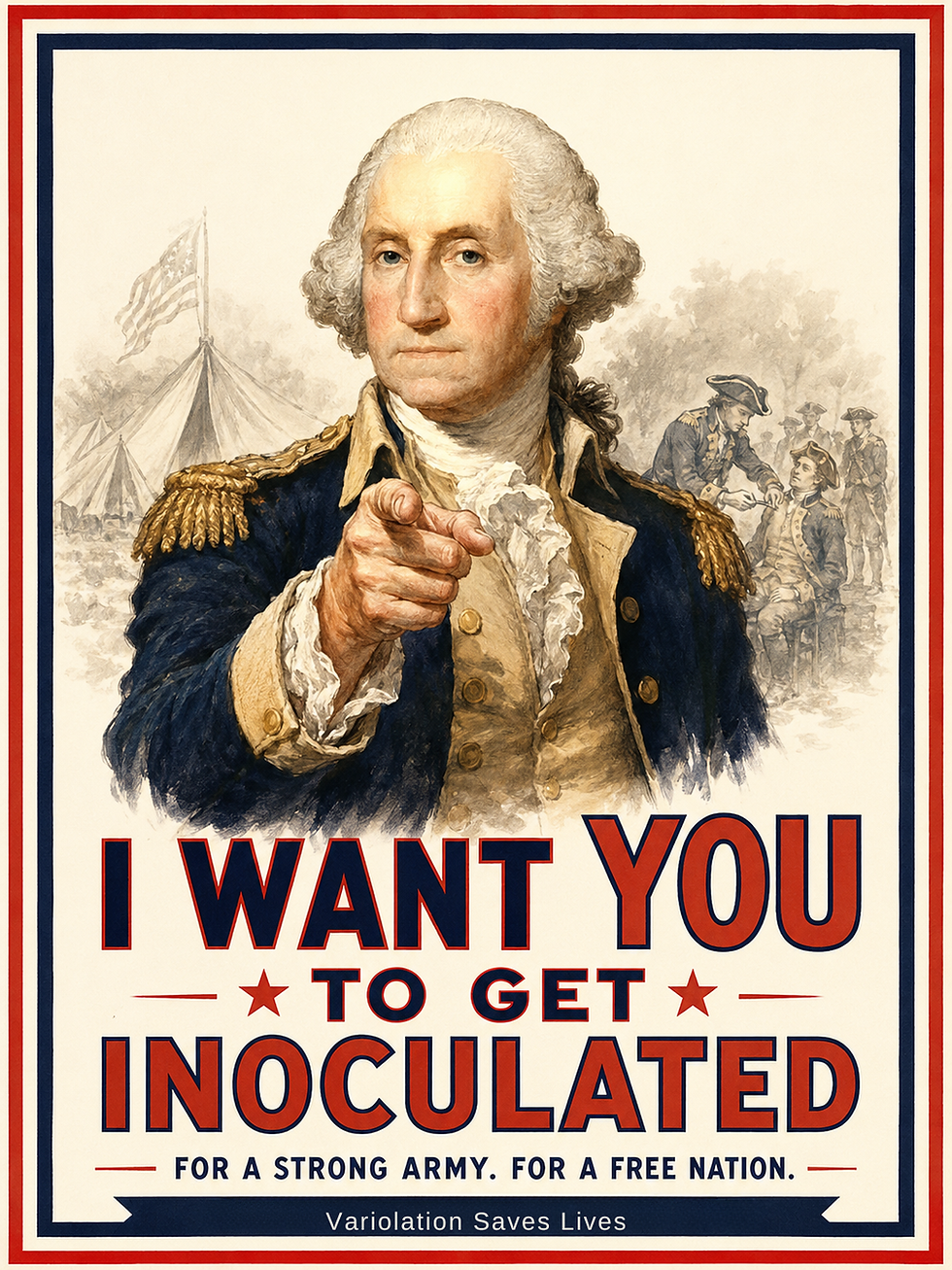
So Washington not only contained cases in his soldiers by implementing public health measures to prevent spread, including isolation of the sick and limited movement of the susceptible, in 1777, he ordered a systematic inoculation program for the Continental Army. The effort had to be carefully managed. Soldiers were inoculated in stages, isolated while they recovered, and then returned to duty after developing immunity. It was a remarkable logistical undertaking at a time when communication was slow, resources were limited, and the science of infectious disease was still centuries from being understood.
Historians continue to debate exactly how much this decision altered the course of the Revolutionary War. Historian Joseph J. Ellis perhaps summarized the significance best. As he told National Geographic, "A compelling case can be made that his swift response to the smallpox epidemic and to a policy of inoculation was the most important strategic decision of his military career."
It's an extraordinary assessment—but it reflects a truth military leaders would learn again and again over the next two centuries: preserving the force is itself a strategic act.
That distinction changed everything. It was an early recognition of a principle that remains central to military medicine today: every preventable illness is a loss of capability.
Washington couldn't see viruses. He knew nothing of bacteria. Germ theory still lay decades in the future. Yet through experience and observation, he recognized something profoundly important. An army doesn't have to lose a battle to be defeated by disease. And once military leaders began to understand that, there was no going back. The question was no longer whether disease mattered. The question became how to stop it.
Building the Science of Prevention
Washington's inoculation order was remarkable, but it didn't solve the larger problem. For decades afterward, armies around the world continued to battle diseases they still didn't fully understand. Soldiers were becoming healthier in some places and sicker in others, but no one yet knew exactly why. The nineteenth century began to change that.
As physicians, scientists, and military leaders accumulated more observations, a new idea slowly emerged. Disease wasn't simply an unavoidable consequence of war. It wasn't caused by bad luck or weak character, nor solely by foul-smelling air drifting through military camps. Increasingly, evidence suggested that illness followed patterns—and if those patterns could be understood, they could be interrupted.
One of the clearest demonstrations came during the Crimean War. When Florence Nightingale arrived at the military hospital in Scutari in 1854, she found conditions that many of us, particularly those living in countries with well-resourced healthcare systems, would struggle to imagine today. Wounded and sick soldiers were crowded into filthy wards. Ventilation was poor. Clean water was limited. Waste accumulated. Basic hygiene was inconsistent, and infection spread rapidly among men who had already survived the battlefield. Many assumed these deaths were simply the unavoidable cost of war.

Nightingale refused to accept that explanation. Working alongside her team, she pushed for cleaner wards, improved ventilation, better nutrition, cleaner water, fresh linens, handwashing, and more systematic sanitation. Just as importantly, she documented what happened. She collected data, tracked mortality, and used statistics to demonstrate that many of the deaths occurring in military hospitals weren't caused by battlefield injuries at all. They were the result of preventable infectious diseases flourishing in unsanitary conditions.
Her work changed more than one hospital. It challenged military leaders to think differently about health itself. If sanitation could dramatically reduce deaths, then cleanliness wasn't simply a matter of comfort. It was an operational advantage.
Nightingale was known as the Lady with the Lamp and you can build your own lamp using these instructions from the Marvelous History website:
Around the same time, scientific discoveries in Europe were beginning to reshape medicine. Researchers such as Louis Pasteur and Robert Koch would eventually establish what became known as germ theory—the understanding that specific microorganisms cause specific diseases. For the first time, physicians could move beyond treating symptoms and begin targeting the causes themselves.
The implications for military medicine were profound. An army could think systematically about prevention. Instead of waiting for disease to appear, commanders could reduce risk by improving sanitation, protecting water supplies, isolating contagious soldiers, inspecting camps, controlling insects and rodents, and paying attention to the conditions that allowed disease to spread in the first place. Slowly, a new philosophy emerged. Military physicians were no longer responsible only for treating wounded soldiers after a battle. They were increasingly responsible for keeping healthy soldiers from becoming patients at all.
Yet it wasn't long before those revolutionary ideas would face one of their greatest tests ...in the mosquito-filled tropics, where infectious disease prevention was complicated by a tiny insect threatening to defeat engineering projects and military operations alike.
Fighting the Mosquito
For centuries, yellow fever and malaria had shaped military campaigns and large engineering projects throughout the tropics. Entire expeditions had been delayed or abandoned as soldiers and workers fell ill. During the French effort to build the Panama Canal in the 1880s, tens of thousands of workers died, many from yellow fever and malaria. The project became synonymous with disease, and eventually, with failure. It wasn't a lack of engineering expertise that stopped construction. It was biology.
At the time, however, scientists still debated exactly how these diseases spread. Many people continued to believe that poisonous air rising from swamps—the so-called "miasma"—was responsible. Swamps certainly seemed connected to illness, but no one understood the real reason.

That began to change in 1900, when the U.S. Army Yellow Fever Commission, led by Walter Reed, conducted a series of groundbreaking experiments in Cuba. Building on earlier work by Cuban physician Carlos Finlay, Reed and his colleagues demonstrated that yellow fever was transmitted not through contaminated clothing or foul air, but by the bite of infected mosquitoes. It was one of the great breakthroughs in the history of infectious disease.
The battlefield expanded beyond the hospital and into the environment. And no one demonstrated the power of that approach more effectively than William Gorgas. As Chief Sanitary Officer during the American construction of the Panama Canal, Gorgas implemented an ambitious public health campaign based on the new understanding of mosquito-borne disease. His teams drained standing water, fumigated buildings, installed screens, treated breeding sites, and built systems to reduce human exposure to mosquitoes. The results were extraordinary.
Yellow fever, once one of the greatest obstacles to construction, was effectively eliminated from the Canal Zone. Malaria cases fell dramatically. For the first time, workers could build in an environment that had previously been considered nearly impossible because of disease. Engineering made the canal possible. Preventive public health made the engineering possible.
It's difficult to overstate how revolutionary this was. Instead of accepting outbreaks as inevitable, military physicians were now reshaping entire environments to prevent them. Disease control had become proactive, systematic, and evidence-based. These ideas quickly spread throughout the military. Preventive medicine expanded beyond sanitation to include surveillance, environmental health, vector control, food safety, water quality, and increasingly sophisticated approaches to protecting troops before illness occurred.
Preparing the Immune System
This was a profound shift in military thinking, but there was still one place military medicine couldn't yet reach. Inside the human body.
No amount of clean water or mosquito control could prevent every infectious disease. Respiratory viruses still spread through crowded barracks. Bacteria continued to move through military camps despite improvements in sanitation. Some pathogens simply required another line of defense. That line of defense was the immune system itself.
The idea had existed in different forms for centuries, but advances in microbiology and immunology during the late nineteenth and early twentieth centuries accelerated the development of vaccines against an increasing number of diseases. For militaries, the appeal was obvious: vaccination offered the possibility of reducing the number of susceptible soldiers before an outbreak ever occurred.
One of the earliest examples came with typhoid fever. During the Spanish–American War, typhoid swept through military camps in the US. More American service members became ill from typhoid than from enemy fire. The outbreak prompted extensive investigation into sanitation and disease transmission and helped drive the adoption of routine typhoid vaccination in the years leading up to World War I. The results were dramatic. Typhoid, once a predictable feature of military life, became far less common among vaccinated troops.
As the twentieth century progressed, military vaccination programs expanded to protect service members against diseases that had historically disrupted military operations. Vaccines for tetanus, influenza, measles, meningococcal disease, hepatitis, and other infectious threats became part of routine force health protection as scientific evidence accumulated and new vaccines became available. Which vaccines were recommended or required evolved over time as diseases changed, technologies advanced, and military needs shifted. But the underlying principle remained consistent.
Military planners often use the term readiness to describe an armed force's ability to perform its mission. When most of us hear that word, we picture aircraft, ships, armored vehicles, sophisticated communications systems, or highly trained personnel. But readiness also means having enough healthy people available to carry out the mission.
An outbreak that sidelines hundreds of recruits can delay training. A respiratory virus spreading aboard a ship can affect operations for weeks. An illness moving through a deployed unit can reduce effectiveness without a single shot being fired. Disease doesn't have to be fatal to become a military problem. It only has to keep people from doing their jobs.
That way of thinking gave rise to what is now known as force health protection—the coordinated effort to preserve the health of military personnel before illness or injury can reduce operational capability. Vaccination became one component of that broader strategy, alongside sanitation, disease surveillance, food and water safety, environmental health, vector control, infection prevention, and rapid outbreak response.
In other words, military medicine had come full circle.
What began with Washington's decision to protect his army from smallpox had evolved into a comprehensive system built around a simple but powerful idea: The strongest fighting force is the one that never has to fight disease in the first place. This, history has shown us. Repeatedly.
The Lessons We Keep Learning
The importance of military vaccination isn't theoretical. The military has seen firsthand what happens when those public health protections disappear. One of the clearest examples involved adenovirus, a common respiratory virus that usually causes mild illness in the general population but can spread rapidly among military recruits living in close quarters. Because outbreaks repeatedly disrupted training, the U.S. military began routinely vaccinating recruits against adenovirus in the early 1970s.
Then, in the late 1990s, vaccine production stopped. The manufacturer ceased production, and the military's supply was eventually exhausted. By 1999, vaccination ended because there was no vaccine available.
The results were immediate. Adenovirus returned to military training centers with remarkable speed. Thousands of recruits became ill. Training was disrupted, hospitals filled with sick trainees, and several recruits died from complications of infection. After a new vaccine was developed and routine vaccination resumed in 2011, adenovirus illness among military recruits fell dramatically once again. It was a powerful demonstration of lessons our military had learned centuries before.
And sometimes, despite decades of scientific progress, an entirely new threat appears.
That happened in 2020, when COVID-19 reached one of the most powerful warships in the world. In March 2020, what began as a handful of COVID-19 cases quickly became a major outbreak aboard the aircraft carrier USS Theodore Roosevelt (CVN-71). More than 1,200 sailors would ultimately become infected. Living quarters were crowded. Sailors shared sleeping areas, workspaces, dining facilities, and narrow passageways. Like military camps centuries before, the very conditions that allowed the ship to function as an effective fighting force also created ideal conditions for a highly contagious respiratory virus.
The outbreak presented military leaders with an extraordinarily difficult problem. An aircraft carrier is one of the United States' most powerful military assets, designed to project force around the world. But a warship depends on its crew. If enough sailors become ill, the ship's capabilities are affected no matter how advanced its technology may be.
Captain Brett Crozier understood that reality. As the number of infections continued to climb, he urged Navy leadership to remove most of his crew from the ship so they could be isolated and treated before the outbreak grew even worse. In a memo that would become widely known, he wrote, "We are not at war. Sailors do not need to die."
The memo was leaked to the press, and Crozier was relieved of command.
Regardless of how one views the decisions that followed, the episode demonstrated, again, something military medicine has understood for generations. An infectious disease outbreak is not merely a medical event. It is an operational event. Commanders are responsible not only for accomplishing the mission but also for preserving the force that carries it out. Sometimes those responsibilities exist in difficult tension with one another.
Six years later, the military is once again confronting an old adversary. In April 2026, the Department of Defense ended the long-standing requirement that service members receive the seasonal influenza vaccine. Only a few months later, an influenza outbreak emerged among recruits at Joint Base San Antonio-Lackland. After the policy change, vaccination rates among trainees dropped to around 40 percent, increasing the number of susceptible individuals in an environment already optimized for respiratory spread. And while outbreaks can occur even in vaccinated populations, reducing vaccination coverage increases the number of susceptible individuals—making spread more likely in high-density settings like basic training.
As of this recording, hundreds of trainees have been reported ill, and one trainee, Keon McDaniel, has died. Representative Joaquin Castro stated that the Air Force confirmed the death was due to influenza. Following the outbreak, military leadership moved quickly to reinstate vaccination requirements for trainees.
Basic military training is almost perfectly designed for respiratory viruses. Thousands of young adults from across the country arrive with different immune histories. They live in close quarters, sleep in shared barracks, eat together, train together, and experience the physical and psychological stress that accompanies basic training. Those conditions help transform civilians into cohesive military units. They also allow influenza to spread with remarkable efficiency.
This is precisely why respiratory diseases have occupied military planners for more than a century. History has a way of reminding us that microbes don't care about politics, ideology, national borders, or military rank. They exploit biology, opportunity, and human behavior exactly as they always have. The invisible enemy has never changed. Only our ability, and our will, to fight it has.
Closing
No battlefield victory marked the birth of military preventive medicine. There was no single moment when the invisible enemy was finally defeated. Instead, the transformation unfolded over generations, as countless physicians, scientists, nurses, military leaders, and service members slowly came to understand that an army doesn't lose its strength only on the battlefield. It can lose it anywhere infectious diseases are allowed to spread unchecked. That realization gave rise to cleaner camps, safer water, vector control programs, disease surveillance, vaccination, and the broader concept of force health protection. Many of those innovations eventually extended far beyond the military, influencing public health practices that continue to protect communities around the world.
And this reveals the paradox of preventive medicine: when it succeeds, it changes how we perceive risk. The very success of prevention can make the diseases it prevents feel distant, while the interventions themselves become more visible and more closely scrutinized.
The moment we stopped accepting infectious disease as an unavoidable cost of human endeavor—and started treating prevention itself as a form of strength—we began gaining ground. Hundreds of years ago, that invisible enemy met generations of people determined to understand it, anticipate it, and stop it. If history offers any guidance, the consequences of weakening those systems are predictable.
Thanks for being here. Next week we continue July's exploration of infectious disease turning points with the birth of the first vaccine. It's the story of how a simple observation became a scientific revolution, and how that revolution continues to shape our world today.
Don't forget to sign up for my free weekly newsletter, Field Notes, where I continue the conversation on the episode, share things I’m paying attention to and outbreak updates, and peak behind-the-scenes. Until next week, stay healthy, stay informed, and spread knowledge, not diseases.
Annotated Citations
Accessing the literature: Whenever possible, I've linked directly to free full-text articles and books that are legally available online. For subscription-only journal articles, check whether a free version is available through an institutional repository, or many researchers are also happy to share a personal copy of their work if you contact the corresponding author. For books, I've included links to free online lending copies or library catalogs when available. If a title isn't freely available online, try searching WorldCat to locate it at a nearby library or ask your local library about interlibrary loan.
Revolutionary War
Lawler, A. 2020. George Washington beat a smallpox epidemic with controversial inoculations. National Geographic.
🌐 Free online resource
➡ Historical overview of smallpox during the American Revolution, Washington's experience with the disease, his 1777 inoculation order, and the strategic significance of the Continental Army's variolation campaign. Includes commentary from historian Joseph J. Ellis describing the inoculation program as potentially Washington's most important strategic military decision.
Fenn, E.A. 2001. Pox Americana: The Great Smallpox Epidemic of 1775–82. New York: Hill and Wang.
📚 WorldCat (find at a library near you)
https://search.worldcat.org/title/pox-americana-the-great-smallpox-epidemic-of-1775-82/oclc/45879842
➡ A definitive history of the Revolutionary-era smallpox epidemic, including detailed treatment of George Washington’s variolation campaign and its strategic implications for the Continental Army.
Crimean War
National Army Museum. Florence Nightingale: The Lady with the Lamp. National Army Museum.
🌐 Free online resource
https://www.nam.ac.uk/explore/florence-nightingale-lady-lamp
➡ Overview of Florence Nightingale's work during the Crimean War, including conditions at Scutari, her sanitation reforms, use of statistical analysis to demonstrate preventable mortality, and her lasting influence on military medicine, nursing, and public health.
Smallman-Raynor, M., Cliff, A.D. 2004. War Epidemics: An Historical Geography of Infectious Diseases in Military Conflict and Civil Strife, 1850–2000. Oxford: Oxford University Press.
📚 WorldCat (find at a library near you)
https://ccl.on.worldcat.org/oclc/316719715
➡ A comprehensive treatment of how infectious diseases have shaped military campaigns and conflicts, including the Crimean War and Nightingale’s reforms, supporting framing of armies “fighting two wars at once” and the rise of preventive military medicine. Likely available through your library.
Yellow Fever & Panama
Reed W. 1902. Recent Researches concerning the Etiology, Propagation, and Prevention of Yellow Fever, by the United States Army Commission. Journal of Hygiene (London).
🆓 Open access
https://pmc.ncbi.nlm.nih.gov/articles/PMC2236023/
➡ Landmark primary source summarizing the findings of the U.S. Army Yellow Fever Commission. Reed describes the experimental evidence demonstrating that yellow fever is transmitted by mosquitoes rather than contaminated clothing or "foul air," and outlines preventive measures based on interrupting mosquito transmission. This work provided the scientific foundation for William Gorgas's mosquito-control campaigns in Cuba and later the Panama Canal Zone, transforming military preventive medicine and tropical public health.
Crosby, M.C. 2006. The American Plague: The Untold Story of Yellow Fever, the Epidemic That Shaped Our History. New York: Berkley Books.
📚 WorldCat (find at a library near you)
https://search.worldcat.org/title/70823341
➡ A narrative history of yellow fever that covers Carlos Finlay, Walter Reed, and William Gorgas, illustrating how understanding mosquito transmission and vector control transformed both military operations and large engineering projects like the Panama Canal.
Vaccination
Roush, S.W., Murphy, T.V. 2007. Historical comparisons of morbidity and mortality for vaccine-preventable diseases in the United States. JAMA.
🆓 Open access
https://doi.org/10.1001/jama.298.18.2155
➡ A foundational analysis quantifying how dramatically vaccine-preventable diseases declined in incidence and deaths after vaccine introduction in the U.S., providing concrete evidence that vaccines contributed substantially—beyond sanitation alone—to reducing infectious disease burden.
Mortimer, E.A. 1978. Immunization against infectious disease. Science.
🔒 Subscription required
https://www.science.org/doi/10.1126/science.347579
➡ A classic overview summarizing how sanitation, quarantine, antimicrobials, and immunization jointly produced more than a 90% decline in infectious disease mortality, useful for contextualizing vaccines as part of a broader preventive framework while rebutting “vaccines did nothing” narratives.
Army Preventive Medicine
Gillett, M.C. 1995. The Army Medical Department, 1865–1917. Washington, DC: Center of Military History, United States Army.
🆓 Open access but only available as PDF so provided here.
➡ An official historical volume detailing the evolution of U.S. Army medical practice, including typhoid in the Spanish–American War and the development and adoption of typhoid vaccination—useful for grounding the discussion of early military immunization.
Adenovirus
Russell KL, et al. 2006. Transmission Dynamics and Prospective Environmental Sampling of Adenovirus in a Military Recruit Setting. The Journal of Infectious Diseases.
🆓 Open access
https://academic.oup.com/jid/article/194/7/877/862744
➡ Investigated how adenovirus spreads within U.S. military recruit training facilities through environmental sampling and epidemiologic surveillance. The study demonstrated extensive environmental contamination and efficient transmission in congregate living settings, providing evidence for why military recruits experience recurrent adenovirus outbreaks and underscoring the importance of preventive measures, including vaccination and infection control.
Radin JM, et al. 2014. Dramatic Decline of Respiratory Illness Among US Military Recruits After the Renewed Use of Adenovirus Vaccines. Clinical Infectious Diseases.
🔒 Subscription required but at the time of publication, Dr. Gray had shared a copy on ResearchGate.
➡ Evaluated the impact of reintroducing adenovirus vaccination among U.S. military recruits after vaccine production resumed in 2011. The study documented approximately a 100-fold reduction in adenovirus-associated respiratory illness across eight military training sites, demonstrating the effectiveness of routine vaccination in preventing outbreaks and preserving recruit health and military readiness.
Modern Military
Kasper, M.R., et al. 2020. An outbreak of Covid-19 on an aircraft carrier. N Engl J Med.
🆓 Open access
https://doi.org/10.1056/NEJMoa2019375
➡ The key clinical and epidemiologic report on the USS Theodore Roosevelt outbreak, providing data on case counts, living conditions, and operational impact, directly supporting the account of COVID-19 as an operational—not just medical—event.
NPR. 2026. Flu outbreak tests new Pentagon vaccine policy. NPR. Published June 20, 2026.
🌐 Free online resource
https://www.npr.org/2026/06/20/nx-s1-5864519/flu-outbreak-tests-new-pentagon-vaccine-policy
➡ Reporting on the influenza outbreak among U.S. military trainees following the Pentagon’s April 2026 decision to end the seasonal flu vaccine requirement. Useful for grounding the episode’s current-event discussion and connecting the Lackland outbreak to broader questions about military readiness, respiratory disease risk, and vaccine policy.
Van Beusekom M. 2026. Quick takes: Flu sickens US troops, Texas reports 3 more NWS cases, eligibility expands for pneumococcal vaccine. CIDRAP News. Published June 22, 2026.
🌐 Free online resource
➡ News brief summarizing early reports of influenza among U.S. troops, alongside other infectious disease updates. Useful as a concise secondary source documenting the outbreak while it was still developing and before peer-reviewed or official outbreak analyses were available.


Comments