


Monsters, Movies, and Microbes: When Infection Becomes Horror.
Summary
It’s horror movie night on Outbreak After Dark, and Heather has already found a way to ruin it with infectious disease.
Joined by fellow horror fan Valerie, Heather follows the real biology hiding beneath some of horror’s most familiar fears—from tuberculosis and vampire lore to rabies and werewolves, outbreak epidemiology and zombies, brain infections and possession, and the real organisms that inspired fungal body-snatcher horror. Along the way, they detour into The Thing, Alien, The Last of Us, and the enduring horror of realizing that the person standing next to you may not be quite what they seem.
Then Valerie gets tested with a round of Horror Movie or Medical Literature?—because sometimes the hardest part is figuring out which nightmare Hollywood invented and which one biology got to first.
Pour something cold, turn down the lights, and whatever you do: stop hiding bites.
Listen here or scroll down to read episode overview or download full transcript.
Full Episode
👉 Download Transcript PDF:
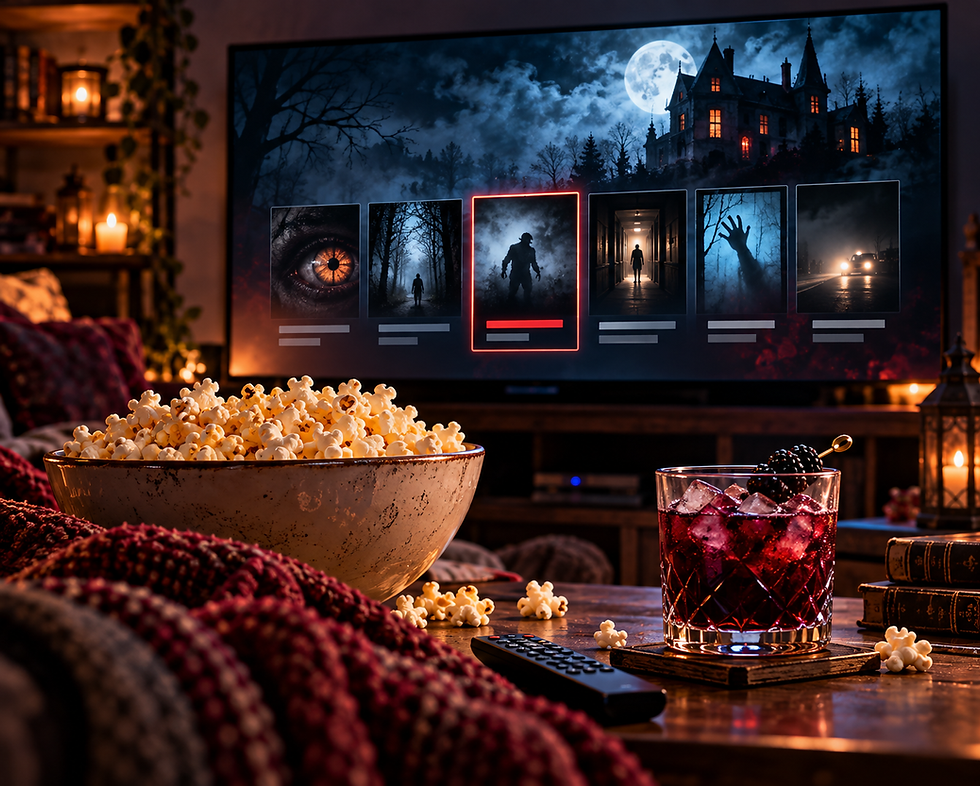
The lights are down. The drinks are cold. The movie is cued up.
And Heather has already found a way to ruin it with infectious disease.
For this month's Outbreak After Dark, fellow horror fan Valerie joins Heather for Monsters, Movies, and Microbes...a late-summer horror movie night with vampires, werewolves, zombies, possession, body snatchers, and the growing realization that some of the things happening in horror movies have uncomfortable parallels in real biology.
Because long before filmmakers gave us monsters, people were already frightened by disease that could transform the body, alter behavior, spread from one person to another, or get inside us without being seen.
So tonight, we're starting with the monsters and working backward.
Monsters, Movies & Microbes
First up: vampires.
In nineteenth-century New England, tuberculosis could move through families while nobody understood what was spreading or why. In some communities, suspicion fell on the dead themselves, leading families to exhume relatives in an attempt to stop the living from following them to the grave.
Then there are werewolves...and rabies, an infection transmitted through animal bites that can remain silent for weeks or months before reaching the brain and producing dramatic neurological symptoms.
Zombies turn out to have their own familiar logic. Once the modern zombie became infectious, the movies began asking some very epidemiological questions: Who has been exposed? How is it transmitted? How long before symptoms appear? And why does somebody always hide the bite?
Stop hiding bites.
We may have accidentally developed a public-health campaign.
Something Else Is Inside the Body
From there, movie night moves into one of horror's favorite violations: something gets inside a body, and its interests are not yours.
The real fungi that alter insect behavior helped inspire The Last of Us. The Thing turns biological invasion into a problem of assimilation, detection, and trust. Alien makes the body itself part of another organism's life cycle. And possession movies tap into another deeply unsettling fear: the possibility that someone you know can suddenly stop behaving like themselves.
The monsters are fictional.
The vulnerabilities they exploit are much more familiar.
Horror Movie or Medical Literature?
Finally, Valerie gets a test.
Heather describes a series of increasingly questionable biological scenarios, and Valerie has to decide whether each one belongs in a horror movie or the scientific literature.
A parasite replaces a fish's tongue.
A virus sends a caterpillar climbing toward the top of a plant before it dies.
A worm changes an insect's behavior to get itself back to water.
And something deeply unnecessary happens to a snail's eyestalks.
Surely horror writers invented at least some of this.
Right?
What We Cover
Tuberculosis and the New England vampire panic
Rabies, animal bites, and werewolf-like transformation
Why the infectious zombie is essentially an outbreak story
The real biology that inspired The Last of Us
The Thing, Alien, and the horror of biological invasion
Neurological disease and the symptoms that can resemble possession
Why horror and infectious disease share so many of the same fears
Horror Movie or Medical Literature?
Recipes and annotated references appear below Heather's signature. Tonight's movie-night menu includes Feature Presentation, with its zero-proof counterpart The Final Girl, plus Last Known Meal and The Thing Inside.
If you'd like to continue the conversation beyond the episode, join my free weekly newsletter, Field Notes. For Outbreak After Dark episodes, that becomes Field Notes: After Dark.
For now, grab something cold, turn down the lights, and whatever you do—
stop hiding bites.

RECIPES AND ANNOTATED REFERENCES


Annotated Citations
Each citation is annotated to explain how the source connects to the episode and to help listeners who want to explore the science in greater depth.
Accessing the literature: Whenever possible, I've linked directly to free full-text articles and books that are legally available online. For subscription-only journal articles, many researchers are happy to share a personal copy of their work if you contact the corresponding author. For books, I've included links to free online lending copies or library catalogs when available.
Bell ME. 2006. Vampires and Death in New England, 1784 to 1892. Anthropology and Humanism.
→ A fascinating scholarly examination of the New England “vampire” tradition during the eighteenth and nineteenth centuries, when tuberculosis could move devastatingly through families. Bell documents cases in which relatives were exhumed and their remains examined or ritually treated in attempts to stop illness among the living. Particularly relevant to the Mercy Brown story.
🔒 Subscription required: https://anthrosource.onlinelibrary.wiley.com/doi/epdf/10.1525/ahu.2006.31.2.124
You can request a copy from the author on Research Gate (scroll down): https://www.researchgate.net/publication/227516987_Vampires_and_Death_in_New_England_1784_to_1892
Hemachudha T, et al. 2013. Human Rabies: Neuropathogenesis, Diagnosis, and Management. The Lancet Neurology.
→ A comprehensive clinical review of human rabies, including how the virus reaches and affects the nervous system, the furious and paralytic forms of disease, hydrophobia and aerophobia, altered behavior, swallowing difficulties and the devastating prognosis once clinical disease develops.
🔒 Subscription required: https://www.thelancet.com/journals/laneur/article/PIIS1474-4422(13)70038-3/abstract
You can request a copy from the authors at Research Gate: https://www.researchgate.net/publication/236250854_Human_rabies_Neuropathogenesis_diagnosis_and_management
Whitehouse ER, et al. 2023. Human Rabies Despite Post-Exposure Prophylaxis: A Systematic Review of Fatal Breakthrough Infections after Zoonotic Exposures. The Lancet Infectious Diseases.
→ A systematic review examining the rare cases in which human rabies developed despite post-exposure prophylaxis. Breakthrough infections were associated with delayed or incomplete treatment and problems with administration. A useful companion to the rabies review because the most important difference between a werewolf bite and a rabies exposure is that reality gives us a highly effective opportunity to intervene.
🆓 Open access: https://pmc.ncbi.nlm.nih.gov/articles/PMC11403119/
Ackermann H-W, Gauthier J. 1991. The Ways and Nature of the Zombi. The Journal of American Folklore.
→ A scholarly examination of the Haitian zombi and its African and Caribbean antecedents. This is useful for separating the Haitian zonbi—embedded in a much older cultural, spiritual and historical tradition—from the contagious, flesh-eating zombie created by modern popular culture. It provides important context for understanding why Hollywood's infectious zombie is not simply a biomedical version of the original Haitian figure.
🆓 Open access with registration: https://www.jstor.org/stable/541551
Munz P, Hudea I, Imad J, Smith? RJ. 2009. When Zombies Attack!: Mathematical Modelling of an Outbreak of Zombie Infection. In Infectious Disease Modelling Research Progress.
→ Yes, this is real. The authors built mathematical models of a zombie outbreak using the same kinds of concepts used in infectious-disease modeling: susceptible populations, infection, latent periods, quarantine and intervention. It is not evidence for actual zombies, obviously...but it is an irresistible mathematical companion to the episode's observation that the modern infectious zombie story is essentially outbreak epidemiology with much worse incident command.
🆓 Full text available (scroll down to find the PDF available): https://math.uchicago.edu/~shmuel/Modeling/
Poulin R, Maure F. 2015. Host Manipulation by Parasites: A Look Back Before Moving Forward. Trends in Parasitology.
→ A critical look at the science behind one of nature's most horror-friendly phenomena: parasites altering host behavior in ways that may benefit the parasite. The authors also emphasize an important scientific caution: observing behavioral changes in an infected animal is not automatically proof that the parasite evolved specifically to manipulate that behavior.
🔒 Subscription required: https://www.cell.com/trends/parasitology/abstract/S1471-4922(15)00166-X
or use direct PDF link from U of Otago: https://share.google/e1slRoqnTkE0vOLTU
van Roosmalen E, de Bekker C. 2024. Mechanisms Underlying Ophiocordyceps Infection and Behavioral Manipulation of Ants: Unique or Ubiquitous? Annual Review of Microbiology.
→ An excellent modern review of the biology behind the famous “zombie-ant” fungi. It examines what researchers know—and still don't know—about how Ophiocordyceps infection produces its striking behavioral effects, including the molecular and physiological mechanisms involved.
🆓 Open access: https://www.annualreviews.org/content/journals/10.1146/annurev-micro-041522-092522
Berdoy M, Webster JP, Macdonald DW. 2000. Fatal Attraction in Rats Infected with Toxoplasma gondii. Proc Biol Sci.
→ The landmark experiment in which researchers found that Toxoplasma-infected rats lost their normal aversion to areas associated with cat odor, providing experimental evidence for a behavioral change that could increase the parasite's chances of reaching its feline definitive host.
🆓 Open access (PDF link below abstract): https://pmc.ncbi.nlm.nih.gov/articles/PMC1690701/
Martinez VO, et al. 2018. Toxoplasma gondii Infection and Behavioral Outcomes in Humans: A Systematic Review. Parasitology Research.
→ A systematic review of research examining associations between Toxoplasma infection and human behavioral outcomes. Some studies reported associations, but the evidence base was small and had important limitations, including cross-sectional designs, small samples and restricted populations.
🔒 Subscription required: https://link.springer.com/article/10.1007/s00436-018-6040-2
But full text made available by authors at Research Gate: https://www.researchgate.net/publication/327030208_Toxoplasma_gondii_infection_and_behavioral_outcomes_in_humans_a_systematic_review
Wesołowska W, Wesołowski T. 2014. Do Leucochloridium Sporocysts Manipulate the Behaviour of Their Snail Hosts? Journal of Zoology.
→ The pulsating snail eyestalks are real. This study investigated whether infection with Leucochloridium—whose conspicuous broodsacs invade the tentacles of terrestrial snails—is associated with behavioral changes that could make infected snails more conspicuous to the birds the parasite needs to complete its life cycle.
🆓 Open access: https://zslpublications.onlinelibrary.wiley.com/doi/10.1111/jzo.12094
Binks SNM, et al. 2026. Encephalitis. The Lancet.
→ A current clinical review of encephalitis and the diverse infectious and immune-mediated conditions that can cause brain inflammation. Particularly relevant to the possession section because encephalitis can produce dramatic neurological and neuropsychiatric symptoms—including altered consciousness, behavioral changes, seizures and abnormal movements—that may look frighteningly unfamiliar to someone who doesn't know what they're seeing.
🔒 Subscription required: https://www.thelancet.com/journals/lancet/article/PIIS0140-6736(26)00363-6/abstract
You can request a copy from the authors at Research Gate: https://www.researchgate.net/publication/404897734_Encephalitis
Bethel WM, Holmes JC. 1977. Increased Vulnerability of Amphipods to Predation Owing to Altered Behavior Induced by Larval Acanthocephalans. Canadian Journal of Zoology.
→ A classic study of tiny freshwater crustaceans called amphipods that can serve as intermediate hosts for acanthocephalan parasites, and infection can alter behaviors such as responses to light and evasive behavior in ways that leave the crustaceans more vulnerable to the predators the parasite needs to reach next.
🔒 Subscription required: https://cdnsciencepub.com/doi/10.1139/z77-013
Thomas F, et al. 2002. Do Hairworms (Nematomorpha) Manipulate the Water Seeking Behaviour of Their Terrestrial Hosts? Journal of Evolutionary Biology.
→ Researchers compared crickets infected with the horsehair worm Paragordius tricuspidatus with uninfected crickets and found that infected animals were more likely to enter the water, where the mature worm can emerge and continue its aquatic life cycle.
🆓 Open access: https://onlinelibrary.wiley.com/doi/full/10.1046/j.1420-9101.2002.00410.x


Comments