


The Collection: Exhibits to Die For
Summary
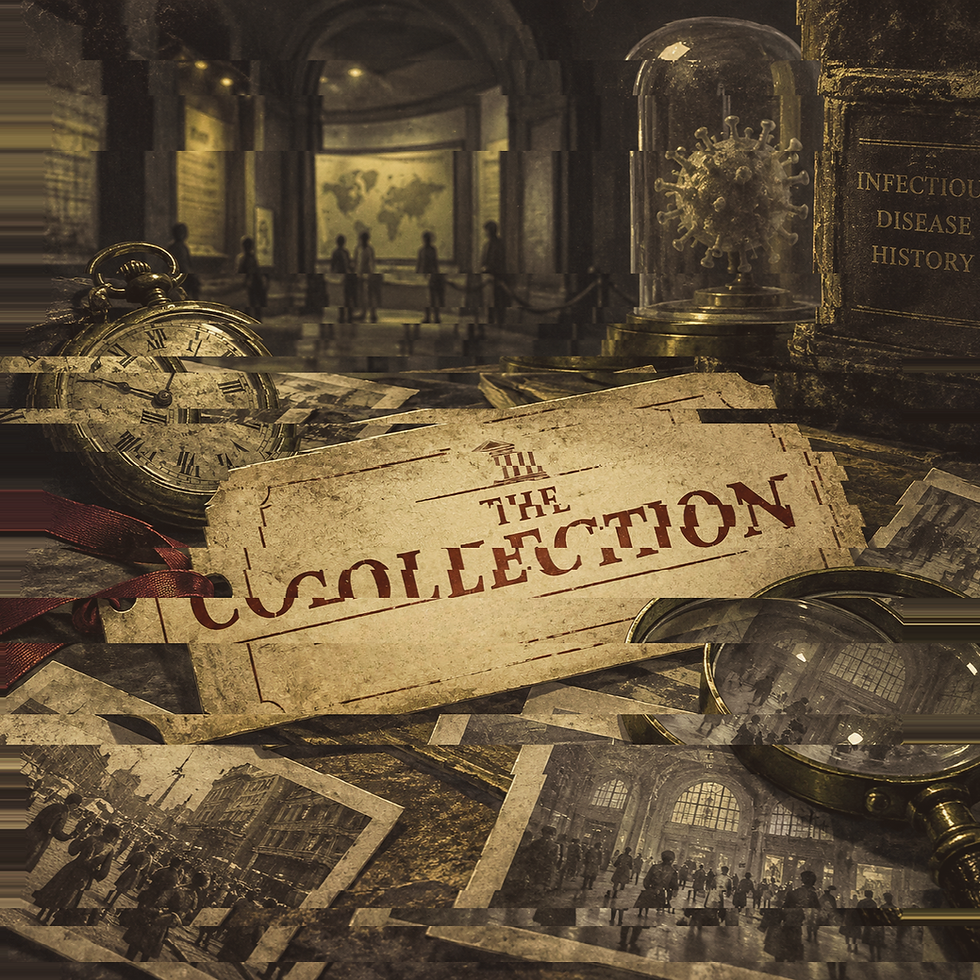
Some museums preserve the past. This one may be collecting something else.
After hours at a museum of infectious disease history, familiar exhibits begin to change. A London street in 1854. A crowded Philadelphia parade in 1918. A Toronto hospital in 2003. Then a train station appears... one that doesn't belong to history at all.
As new galleries open and the same moment begins to repeat, the line between exhibit and prediction starts to disappear.
The Collection opens this year's Month of the Macabre with an immersive audio story about outbreaks, transmission, and the unsettling difference between seeing what might happen and being able to stop it.
🎬 This week's #SickFlicks: Annihilation (2018) and The Endless (2017)—two films about entering places where familiar rules no longer seem to apply, and where understanding what's happening may be much harder than recognizing that something is wrong.
Listen here or scroll down to read the episode overview.
The complete episode transcript is available for download:
Episode Overview
What if a museum of infectious disease history stopped showing you the past?
The Collection begins after closing, inside a museum built around moments when infectious disease changed the course of human lives. Its galleries preserve recognizable scenes from outbreak history: Broad Street in 1854, where John Snow’s investigation of cholera helped transform our understanding of disease transmission; Philadelphia in 1918, where thousands gathered for a wartime parade as influenza spread through the city; and Toronto in 2003, during the SARS outbreak that tested hospitals and public health systems in a world newly confronting the threat of an emerging coronavirus.
These are events we can look back on. We know what happened. We know what came next.
Then the museum changes.
A gallery appears that no one remembers installing. Inside is an ordinary modern train station. Commuters walk past one another. Announcements echo through the concourse. Luggage rolls across the floor. Someone coughs.
And unlike the museum’s other exhibits, this one doesn’t have a date in the past.
As the same captured moment plays again and again, small details begin to matter. A cough. A stranger. A few seconds of contact that would normally disappear unnoticed into an ordinary day. And when the museum begins opening still more galleries, the question is no longer simply what the exhibits are showing.
It’s why they are changing.
This episode uses immersive fiction to explore something very real about infectious disease: transmission is often built from mundane moments. A train station. A wedding. A lecture hall. An airport gate. Most encounters lead nowhere. Some become links in a chain that no one recognizes until much later.
Outbreak investigation usually works backward, reconstructing those chains after illnesses have already occurred. The Collection turns that process around and asks what it would mean to see the possibilities before they become history.
The science remains grounded in real infectious disease concepts, but this is Month of the Macabre, so the museum has a few rules of its own. And it may be better not to assume that you're only there to observe.
This Week’s #SickFlicks
🎬 Annihilation (2018) — A team enters an expanding zone where familiar biological rules have begun to change. The deeper they travel, the harder it becomes to understand whether what they are witnessing is destruction, transformation—or something that doesn't fit neatly into either category.
🎬 The Endless (2017) — Two brothers return to the isolated community they escaped years earlier and discover that time, repetition, and cause and effect may not behave quite the way they should. It’s an especially good companion to this episode’s creeping realization that repetition may be telling you something.
Neither film is a conventional outbreak movie. Instead, both share this episode's unease: you've entered a system whose rules you don't understand, and realizing that the rules exist doesn't necessarily mean you can escape them.
🎧 Headphones recommended. Sound is part of the storytelling in this episode, from the environments inside individual exhibits to details that recur and may not mean quite what they seem to mean the first time you hear them.
And join us next week for an...unpleasant...trip to the dentist.

Annotated Citations & Further Reading
Tulchinsky TH. 2018. John Snow, Cholera, the Broad Street Pump; Waterborne Diseases Then and Now. Case Studies in Public Health.
→ A highly readable review of the 1854 Broad Street cholera outbreak, John Snow’s investigation, the evidence linking disease to contaminated water, and why the episode became a landmark in the development of epidemiology.
🆓 Open Access: https://pmc.ncbi.nlm.nih.gov/articles/PMC7150208/
Elderfield R, Barclay W. 2011. Influenza Pandemics. Advances in Experimental Medicine and Biology.
→ A review of influenza pandemics that includes the devastating 1918 pandemic and the Philadelphia Liberty Loan parade featured in the museum. The Philadelphia example is a stark illustration of what can happen when a respiratory epidemic collides with a large public gathering.
🆓 Full text available: https://pmc.ncbi.nlm.nih.gov/articles/PMC7123151/
Parashar UD, Anderson LJ. 2004. Severe Acute Respiratory Syndrome: Review and Lessons of the 2003 Outbreak. International Journal of Epidemiology.
→ A contemporary review of the first SARS epidemic, covering the emergence and international spread of SARS-CoV, clinical disease, transmission, outbreak epidemiology, and containment. It also examines the major role of health-care settings in transmission, including Toronto, where patients, visitors, and health-care workers were all affected.
🆓 Full text available: https://pmc.ncbi.nlm.nih.gov/articles/PMC7108628/



Comments