Field Notes #2: When Infection Doesn't End
- Heather McSharry, PhD

- Apr 22
- 3 min read
Issue #2
When Infection Doesn't End
On persistence and what gets lost when infection is treated as an event
Welcome to Field Notes.
Each week, I take one idea from the episode—something that feels like a hinge point—and follow it where it leads. Not to repeat the science, but to see what it reveals.
If you want the full story, you can read or listen to the episode here.
In the Margins
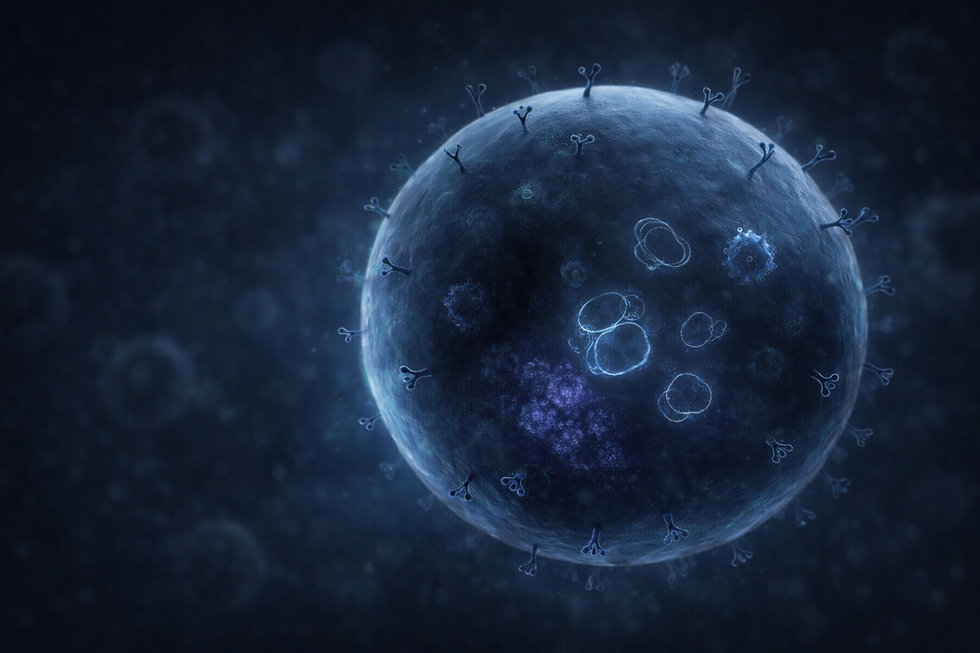
Most of the time, we treat infection like something that declares itself and then resolves. But some infections don’t end in any meaningful sense. They persist as something quieter. Embedded. Ongoing.
And when an infection doesn’t resolve, then “recovery” is not just inaccurate, it's misleading. It suggests an absence that isn’t really there.
Epstein–Barr virus is one example. It settles into the same long-lived cells designed to remember past threats. What looks like resolution is, biologically, a transition. And that shift from event to condition, does more than change the timeline. It changes what we’re able to see.
When effects emerge later, they don’t look like ongoing infection. They look like something new and unrelated. Which means they’re usually treated that way—studied in isolation, diagnosed without context, disconnected from their origin.
So the limitation isn’t just biological. It’s structural. And if the problem is structural—if we’re misclassifying ongoing infections as completed events—then the question isn’t just what are we missing? It’s how would we know?
Because the quiet part of these infections shows up indirectly. Through patterns that only make sense if you stop treating the infection as something finished. So instead of looking for a single signal, it helps to look for a cluster of them: indicators that the model might be wrong.
Underlined
These are the patterns worth paying attention to. They aren’t signs of a new pathogen. They’re signs we may be looking at the wrong timeline:
High prevalence paired with low acute severity
→ The infection may not be benign—its impact may be distributed over time rather than concentrated in the initial illness.
A long gap between infection and disease
→ Later conditions may be disconnected from earlier exposures simply because the link is difficult to see, not because it isn’t there.
Associations with multiple, seemingly unrelated outcomes (autoimmunity, malignancy, chronic disease)
→ The infection may be interacting with host systems over time, rather than causing a single discrete outcome.
Persistence within long-lived or self-renewing cell types
→ The pathogen may be embedding itself within biological systems designed to endure, making elimination less relevant than control.
Research shifting from acute disease to long-term mechanisms
→ The field may be recognizing that what looked like resolution was actually transition.
Individually, these don’t look like much. Together, they point to a different category of disease—one defined less by disruption, and more by duration.
Most of these signals aren’t things you would notice directly. They show up in how symptoms are explained, how conditions are separated from one another, and in how often the answer is some version of “that shouldn’t be related.”
Which means the gap isn’t just in the biology. It’s in what gets connected and what doesn’t. And in how easily those connections are lost over time.
What It Points To
When we treat infections as discrete events, we separate the consequences from their cause.
Postscript
Thank you for subscribing. 🫶
Lately, I’ve been circling a different kind of question. Not about outbreaks, or even about specific pathogens—but about how often microbes are part of things we don’t think of as “infection” at all.
Baking. Old bookstores. Gardening. Spaces and experiences we tend to think of as entirely human—but aren’t, really. I don’t have a clean way of talking about that yet. It’s still more of a thread than a plan. But the idea keeps showing up in different places, and I’m starting to pay attention.
And soon, I’m stepping into a very different perspective through an interview with an ER nurse, looking at how all of this shows up at the point where systems actually meet people. What gets recognized. What gets missed. What it looks like in real time and who pays the price when our systems fail.
— Heather


Comments