Remedies and Regrets: The Worst Infection Treatments in History
- Heather McSharry, PhD

- Apr 29
- 6 min read
Summary
For most of human history, doctors were trying to treat infections without knowing microbes existed. What they had instead were theories—about balance, humors, and invisible forces—and a willingness to act on them.
In this Outbreak After Dark episode, we step into that world: where bloodletting was routine, mercury was medicine, and treatments could be as desperate as they were creative. Some caused harm. Some accidentally helped. And a few pointed toward the science we rely on today.
Because the history of medicine isn’t just a story of progress. It’s a story of trial, error, and the long path to understanding what we’re actually fighting.
Listen here or scroll down to read episode overview or download full transcript.
Episode Overview
Heather’s Note: This episode explores the history of infection treatment before germ theory—when doctors were working without knowing microbes existed. Many of these treatments seem shocking today, but they reflect real attempts to understand and fight disease with the knowledge available at the time. The goal here is context, not judgment.
👉 Download Transcript PDF:
NOTE: When possible, in-text citations linking to papers behind paywalls, are provided as PDFs in the citation list at the end of the post.
Imagine sitting across from a doctor in the year 1700—feverish, exhausted, hoping for relief. He listens. He nods. He reaches for a treatment he believes might save you. And if you knew what it was… you'd hesitate.
In this Outbreak After Dark episode, we step into a period of medicine shaped by guesswork, observation, and desperation. Before microbes were known, before antibiotics existed, and before infection had a clear cause. Because for most of human history, doctors were trying to treat something they couldn’t see.
Medicine Before Microbes
For nearly 2,000 years, medical practice was guided by the theory of the four humors: blood, phlegm, black bile, and yellow bile. Illness wasn’t caused by pathogens. It was caused by imbalance. That framework led to treatments designed to “restore balance”, even when the real problem was infection. And sometimes, those treatments made things worse.
When Treatment Became Harm

Many of the most common historical treatments were based on the idea of removing or purging something “bad” from the body. That included:
Bloodletting, sometimes repeated multiple times during illness
Leech therapy, used at massive scale across Europe
Mercury treatments, especially for diseases like syphilis
From a modern perspective, these interventions often weakened patients already fighting infection. But at the time, they followed the best available logic. Doctors weren’t trying to harm patients.They were working within the limits of what they understood.
When Medicine Got… Creative

Some treatments went further—into territory that feels almost surreal today. Tobacco smoke enemas were used in the 18th century to revive drowning victims and treat a wide range of illnesses. Practitioners believed smoke could warm the body and stimulate breathing, even placing resuscitation kits along the Thames for public use. It sounds absurd now. But within the framework of the time, it made a kind of sense.
When Strange Ideas Actually Worked
Not every unusual treatment was entirely misguided. Some came surprisingly close to the truth:
Malariotherapy used fever to slow neurosyphilis before antibiotics existed
Garlic showed real antimicrobial activity
Mold-based remedies foreshadowed antibiotics
Maggot therapy helped clean infected wounds
These moments reveal something important—medicine wasn’t just guessing blindly. It was observing patterns, sometimes brushing up against real biological effects without fully understanding them.
When “Gross” Became Evidence-Based
The episode ends with one of the most striking examples of modern medicine embracing something that still feels instinctively uncomfortable: Fecal microbiota transplantation (FMT). Used to treat recurrent Clostridioides difficile infections, FMT works by restoring the gut microbiome—reintroducing beneficial microbes that can outcompete harmful bacteria.
It’s highly effective in many cases. And it challenges a familiar assumption: That something can feel unsettling… and still be scientifically sound.
The Turning Point
Everything changed when medicine stopped treating symptoms as imbalance—and started understanding infection as a biological process. The emergence of germ theory in the late 1800s transformed medicine:
Pathogens could be identified
Transmission could be studied
Treatments could be targeted
For the first time, doctors weren’t guessing at an invisible problem. They were studying it.
Why This History Matters
The treatments we’ve covered—bloodletting, mercury, smoke enemas, malariotherapy—may seem distant or even absurd. But they reflect something deeply human: the drive to act in the face of uncertainty. And they offer a reminder. Progress in medicine doesn’t just come from new discoveries. It depends on something more fragile—our willingness to trust evidence when we find it. Because without that…we don’t move forward. We repeat.
What We Cover
How pre-germ theory medicine understood infection
The role of humoral theory in shaping treatment
Why bloodletting and mercury were so widely used
The history and logic behind tobacco smoke enemas
Malariotherapy and early attempts at targeted treatment
Examples of historical remedies that partially worked
The science behind fecal microbiota transplantation
How germ theory transformed medicine
Why this history still matters today
Sometimes medicine was wrong. Sometimes it was close. And sometimes… it stumbled onto the truth for reasons it didn’t yet understand.
Heather and Kate close in unison:
By the fire we meet
With food, drink, and infectious creep.
This is Outbreak After Dark.
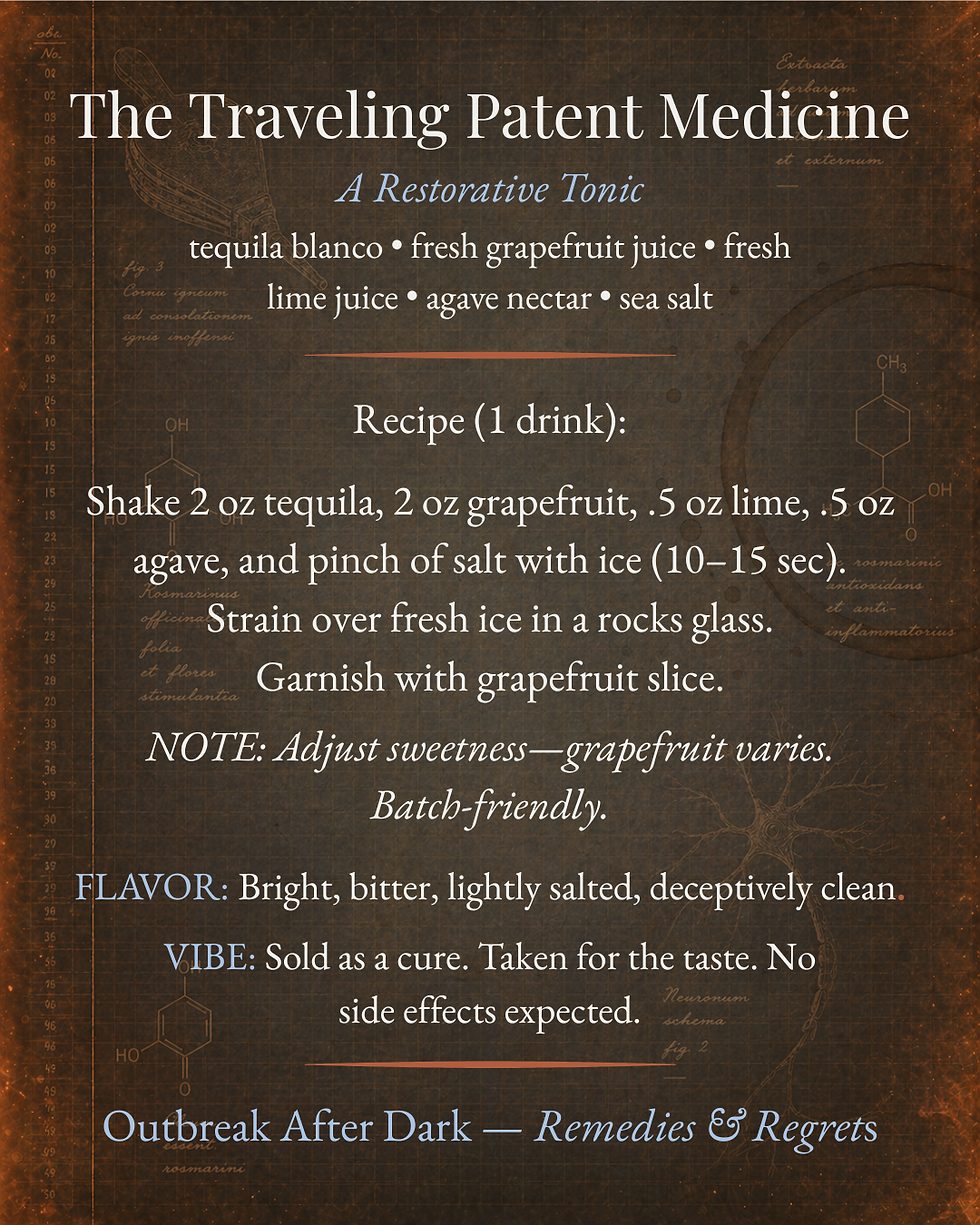
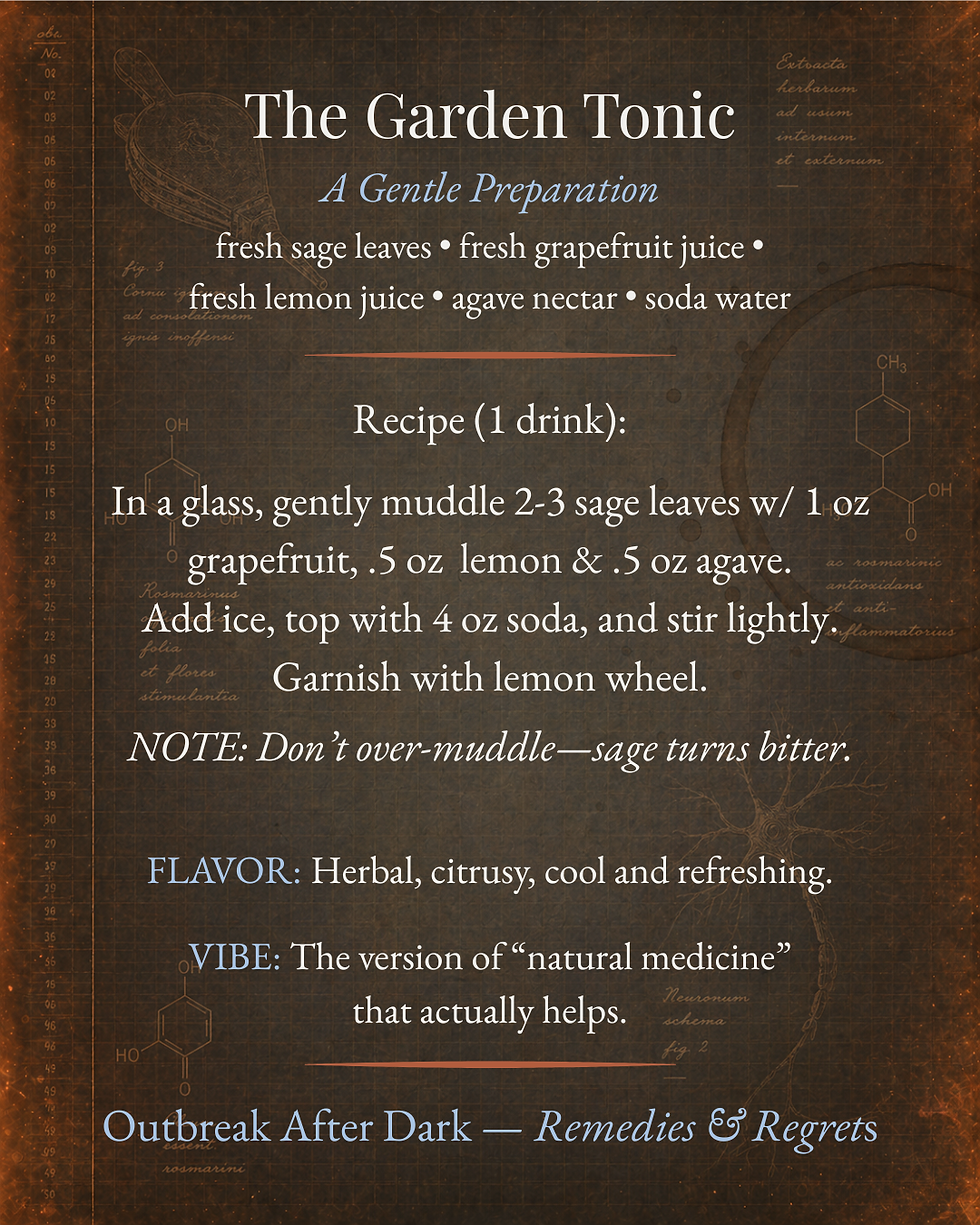
Recipes and references appear below the signature. The Traveling Patent Medicine, Garden Tonic, Apothecary Pretzel Knots, and Victorian Lemon Posset are ready when you are.

If you If you want to continue the conversation beyond the episode, you can join my free weekly newsletter, Field Notes. Each issue picks up one idea and follows it a little further. For Outbreak After Dark episodes, that becomes Field Notes: After Dark—the same conversation, just in the same strange, atmospheric vein as the show.
Stay curious. Stay healthy. And maybe… appreciate your antibiotics a little more tonight.

REMEDIES AND REGRETS MENU RECIPES


ANNOTATED REFERENCES
History of Medicine
Devlin, MA. 2025. What Is the Theory of the Four Humors? TheCollector.com. https://www.thecollector.com/what-is-four-humors-theory/
A clear, accessible overview of the four humors theory that shaped medical thinking for nearly two millennia. This piece helps explain the framework behind practices like bloodletting and purging, illustrating how physicians interpreted disease before the development of germ theory.
Porter, R. 1998. The Greatest Benefit to Mankind: A Medical History of Humanity. W.W. Norton & Company. https://archive.org/details/greatestbenefitt00port
A comprehensive history of medicine that provides essential context for how physicians understood disease before germ theory, including the persistence of humoral theory and the logic behind early treatments.
Humoral Theory & Bloodletting
Wootton, D. 2006. Bad Medicine: Doctors Doing Harm Since Hippocrates. Oxford University Press. https://archive.org/details/badmedicinedocto0000woot/page/n5/mode/2up
Examines how long-standing medical practices like bloodletting persisted despite limited effectiveness, highlighting how deeply entrenched theories shaped treatment decisions before scientific evidence.
Leeches (Historical to Modern Use)
Whitaker, I.S., et al. 2011. Medicinal leeches and the microsurgeon: a review. Microsurgery. https://onlinelibrary.wiley.com/doi/10.1002/micr.20860
Explores the modern clinical use of leeches in reconstructive surgery, providing an important bridge between historical practice and evidence-based medicine.
Mercury & Syphilis
Quétel, C. 1990. History of Syphilis. Johns Hopkins University Press. https://archive.org/details/historyofsyphili0000clau
A detailed historical account of syphilis and its treatments, including the widespread use of mercury and the social and medical consequences of the disease prior to antibiotics.
Tobacco Smoke Enemas & Resuscitation
Lawrence, G. 2002. Tools of the trade: tobacco smoke enemas. The Lancet.
A historical overview of tobacco smoke enemas, including their use in resuscitation practices and the beliefs that supported their adoption in 18th-century medicine.
Malariotherapy (Pre-antibiotic Treatment)
Raju, T.N.K. 1999. The Nobel chronicles: Julius Wagner-Jauregg (1857–1940). The Lancet.
Reviews the development of malariotherapy for neurosyphilis and the reasoning behind it, illustrating one of the first instances of a targeted—if unconventional—biological treatment.
Fecal Microbiota Transplantation (FMT)
van Nood, E., et al. 2013. Duodenal infusion of donor feces for recurrent Clostridium difficile. N Engl J Med. https://www.nejm.org/doi/full/10.1056/NEJMoa1205037
A landmark clinical trial demonstrating the high efficacy of fecal microbiota transplantation for recurrent C. difficile infection, helping establish FMT as a modern therapeutic option.
Drekonja, D., et al. 2025. A Randomized Controlled Trial of Efficacy and Safety of Fecal Microbiota Transplant for Preventing Recurrent Clostridioides difficile Infection, Clinical Infectious Diseases. https://academic.oup.com/cid/article/80/1/52/7756590
A randomized controlled trial showing that FMT outcomes may be more variable than earlier studies suggested, underscoring the need for continued research into timing, dosing, and patient selection.
Access & Regulation of FMT
Boodman, E. 2026. Her son needed a fecal transplant… Getting one required a tortuous journey. STAT News.
Investigates how stricter donor screening and regulatory changes have limited access to FMT, highlighting real-world challenges in delivering this therapy to patients.
“Accidentally Effective” Treatments (Garlic, Mold, Maggots)
Ankri, S., and Mirelman, D. 1999. Antimicrobial properties of allicin from garlic. Microbes and Infection. https://www.sciencedirect.com/science/article/pii/S1286457999800033?via%3Dihub
Demonstrates the antimicrobial activity of garlic-derived compounds, supporting historical observations that garlic could help slow infection.
Wainwright, M. 1989. Moulds in ancient and more recent medicine. Mycologist.
Paywalled so:
[PDF coming soon]
This article traces the historical use of molds in medicine, showing how ancient and early modern practitioners applied moldy materials to wounds long before the discovery of antibiotics.
Sherman, R.A. 2003. Maggot therapy for treating diabetic foot ulcers. Diabetes Care.
Explains the modern medical use of sterilized maggots for wound debridement and infection control, illustrating how an ancient observation became a validated treatment.
Germ Theory & the Turning Point in Medicine
Brock, T.D. 1999. Robert Koch: A Life in Medicine and Bacteriology. ASM Press.
Details Koch’s contributions to germ theory and the identification of specific disease-causing organisms, marking a critical shift from symptom-based to cause-based medicine.


Comments