


The Bell, the Beak, and the Mark: Plague Doctors and the Fear of Contagion
Updated: Sep 5
Summary

The plague doctor is one of the most recognizable figures in the history of medicine—beaked mask, dark robes, an image that feels both theatrical and deeply unsettling. But the story behind that mask is far more complicated than the myth.
In this episode of Outbreak After Dark, we trace the evolution of the plague doctor from early attempts to understand the Black Death to the rise of quarantine systems and epidemic bureaucracy. Along the way, we ask a deceptively simple question: were plague doctors healers… or something darker?
The answer sits somewhere in between and is why plague doctors remain part of our collective subconcious. They represent something timeless: the tension between care and distance, between protection and compassion, between showing up—and knowing it may not be enough.
Listen here or scroll down to read episode overview or download full transcript.
Episode Overview
Heather’s Note: This episode explores historical practices during the Black Death, including treatments that were ineffective or harmful. The goal is to understand—not sensationalize—the context in which these decisions were made. Plague doctors were not villains or heroes, but people working within the limits of their time.
Recipes and references are at the end of the post after the signature.
👉 Download Transcript PDF:
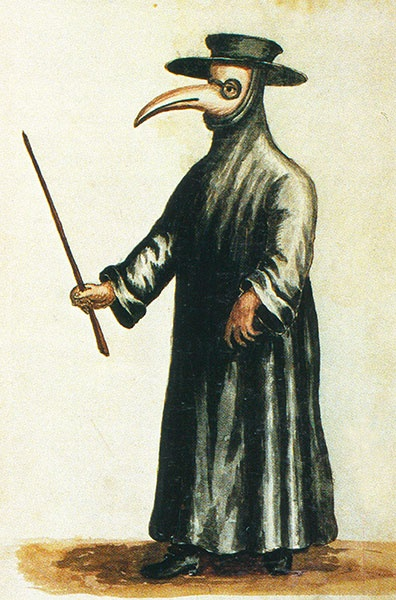
The plague doctor is one of the most haunting images in medical history.
A black cloak. A wide-brimmed hat. A cane. And a beak filled with herbs meant to filter “bad air.”
It looks theatrical. Almost absurd. But it wasn’t designed to frighten. It was designed to protect.
In this Outbreak After Dark episode, we follow the plague doctor from myth to reality—through early theories of disease, the rise of quarantine systems, and the uneasy role of physicians during one of the deadliest pandemics in human history.
Because the truth is more complicated than the costume.
Plague doctors were not wandering healers offering cures. They were often hired by city governments to document cases, enforce isolation, and manage the spread of disease. Their presence marked a shift—from private illness to public crisis. And while most of their treatments failed, some of their instincts—especially quarantine—hinted at the foundations of modern public health.
From Miasma to Misunderstanding
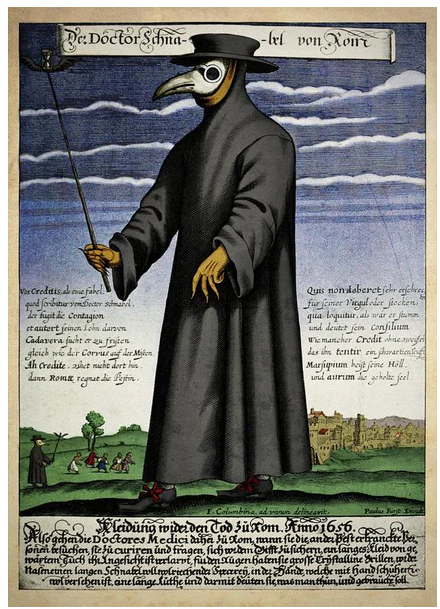
The episode begins with the dominant medical theory of the time: miasma, or “bad air.” Plague doctors filled their beaked masks with herbs, spices, and perfumes, believing they could purify the air they breathed.
The science was wrong. But the intent—to create protection—was real.
Did Anything Actually Work?
Most treatments did not.
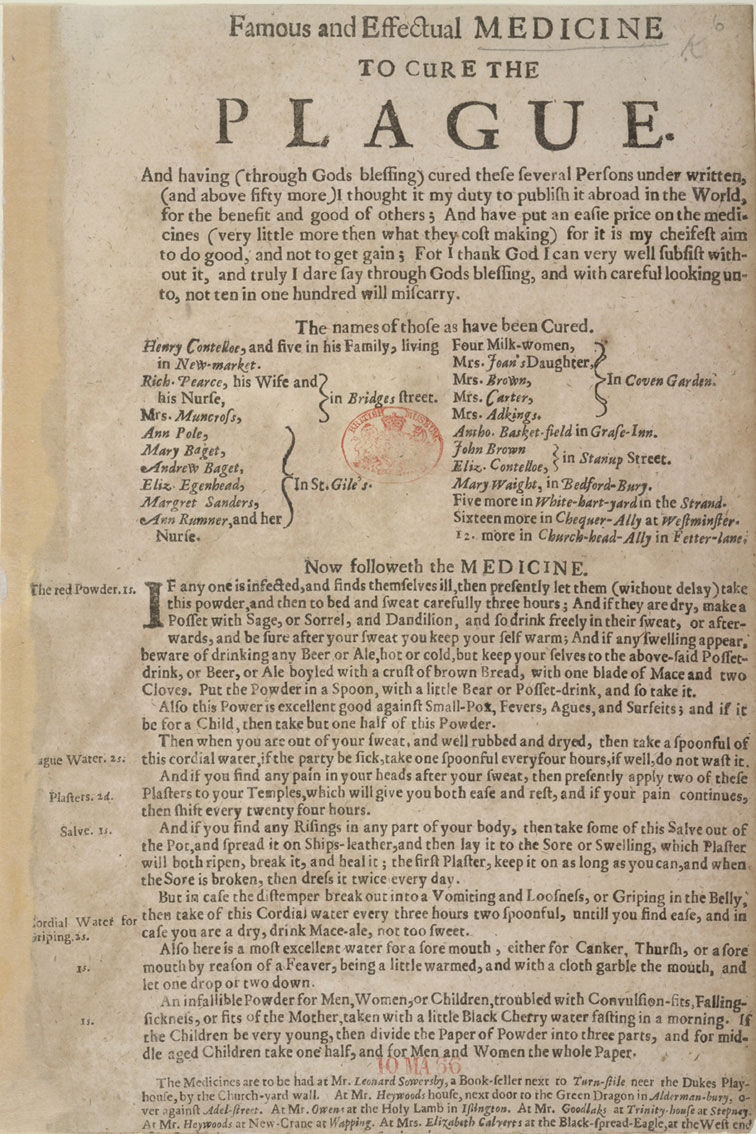
Bloodletting weakened patients. Herbal fumigation did nothing to stop Yersinia pestis. Balancing humors addressed a problem that didn’t exist. But some interventions helped—accidentally.
Isolation. Reduced movement. Quarantine.
Cities began restricting travel and requiring ships to wait offshore for forty days—quaranta giorni—before allowing passengers to disembark.
They didn’t understand pathogens. But they recognized patterns. Disease spread slowed when people stopped moving.
The Plague Doctor as a System
Plague doctors were not just physicians.
They were part of an emerging system.
They recorded deaths. Certified cases. Recommended quarantine. Marked homes.
Their presence often signaled that a situation had escalated—that illness was no longer private. For many, the arrival of a plague doctor did not mean hope. It meant inevitability.
Distance, Fear, and the Human Inside the Mask
The episode then turns inward. What did it feel like to be inside the mask?
Through a modern reflection from the COVID-19 pandemic, we explore how protective equipment—whether a beaked mask or an N95—creates distance between patient and provider.
That distance can feel cold. But it also makes care possible.
Why the Image Endures
We also examine why this image is so enduring and iconic. Because the plague doctor captures something timeless. The tension between care and distance. Between protection and compassion. Between showing up—and knowing it may not be enough.
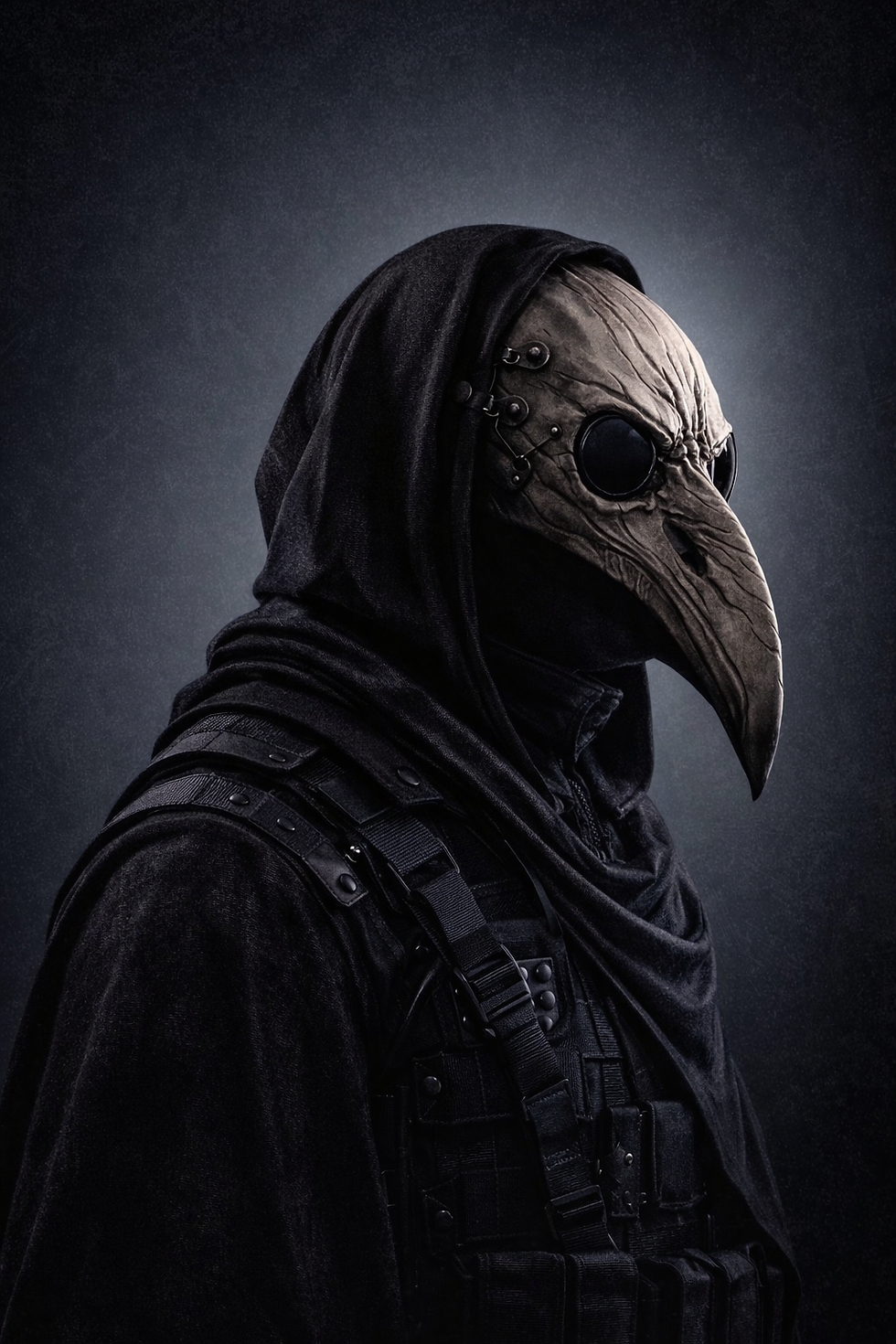
Today, the image lives on in Halloween costumes, art, and popular culture. We wear it ironically. But the fear underneath it is real. Because even now, in modern medicine, we understand that protection sometimes requires distance—and that distance changes how care feels.
What We Cover
What plague doctors actually did during the Black Death
The miasma theory and the origin of the beaked mask
Why most historical treatments failed
How quarantine emerged as an early public health tool
The role of plague doctors in surveillance and epidemic control
The emotional impact of distance in medical care
A modern reflection on PPE and masked medicine
Why the plague doctor remains a powerful cultural symbol
“Sometimes protection creates distance. Sometimes distance feels like fear. And sometimes… it’s the only way care is possible.”
By the end of the night, the plague doctor is no longer just a costume. It is a symbol of medicine in its most human form—imperfect, evolving, and trying anyway.
And around the fire, that complexity is what lingers. The plague doctor survives as a ubiquitous costume because it captures a question we are still wrestling with:
What does medicine look like…when it cannot save everyone?
Heather, Kate, and Sam close in unison:
By the fire we meet
With food, drink, and infectious creep.
This is Outbreak After Dark.
Recipes and references appear below the signature.
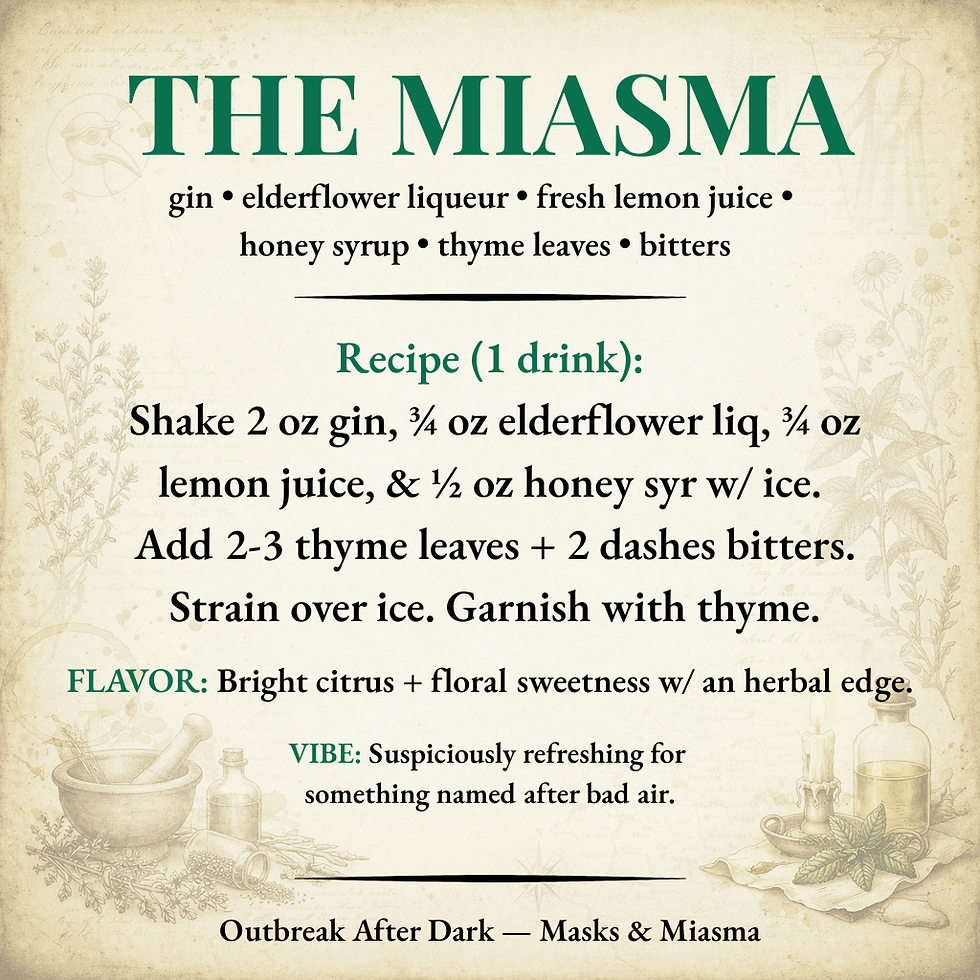
Plaguehouse Hand Pies, Pomander Cakes, The Miasma, and The Beaked Apothecary are ready when you are.
Stay curious. Stay Healthy. And maybe… keep a little distance when the beak appears.

RECIPES


REFERENCES
Byrne, JP. 2012. Encyclopedia of the Black Death. Santa Barbara, CA: ABC-CLIO. https://archive.org/details/encyclopediaofbl0000byrn
Byrne's work describes the plague doctor costume and attributes its design to Charles de Lorme, c. 1619.
Ayyadurai S, et al. 2010. Body lice, yersinia pestis orientalis, and black death. Emerg Infect Dis. https://pmc.ncbi.nlm.nih.gov/articles/PMC2953993/
Bramanti B, et al. 2021. Assessing the origins of the European Plagues following the Black Death: A synthesis of genomic, historical, and ecological information, Proc. Natl. Acad. Sci. U.S.A. https://www.pnas.org/doi/10.1073/pnas.2101940118?url_ver=Z39.88-2003&rfr_id=ori:rid:crossref.org&rfr_dat=cr_pub%20%200pubmed
Hajar, R. 2021. Medicine from Galen to the Present: A Short History. Heart Views. https://journals.lww.com/hrtv/fulltext/2021/22040/medicine_from_galen_to_the_present__a_short.15.aspx
Conti, AA. 2020. Protective face masks through centuries, from XVII century plague doctors to current health care professionals managing the COVID-19 pandemic. Acta Biomed. https://pmc.ncbi.nlm.nih.gov/articles/PMC7927518/
Gunnoe, C. D. 2025. Paracelsus and the Tyrolean Plague Epidemic of 1534: context and analysis of Von der Pestilentz an die Statt Stertzingen. Annals of Science. https://www.tandfonline.com/doi/10.1080/00033790.2024.2337136?url_ver=Z39.88-2003&rfr_id=ori:rid:crossref.org&rfr_dat=cr_pub%20%200pubmed
Earnest, M. 2020. On Becoming a Plague Doctor. N Engl J Med. https://www.nejm.org/doi/full/10.1056/NEJMp2011418
The piece explores the emotional and professional challenges of being a physician during the early stages of the COVID-19 pandemic.
The Report of the Paris Medical Faculty, October 1348. https://sites.uwm.edu/carlin/the-report-of-the-paris-medical-faculty-october-1348/
The University of Paris medical faculty, at King Philip VI’s request, reported that the Black Death was caused by a catastrophic March 20, 1345, triple conjunction of Saturn, Jupiter, and Mars in Aquarius.
Slack P. 1988. Responses to plague in early modern Europe: the implications of public health. Soc Res (New York). https://pubmed.ncbi.nlm.nih.gov/11650270/
Paul Slack demonstrates how European cities institutionalized public health responses, including hiring salaried plague physicians. Slack’s work is foundational for understanding the bureaucratic context in which plague physicians worked.
Crawshaw, JLS. 2016. Plague Hospitals: Public Health for the City in Early Modern Venice. Routledge. https://www.taylorfrancis.com/books/mono/10.4324/9781315600680/plague-hospitals-jane-stevens-crawshaw
This study of Venetian lazaretti (plague hospitals) provides direct insight into how plague doctors worked within quarantine infrastructure. No free book available but here is the 30 page preview PDF offered by the publisher:
Cipolla, CM. 1976. Public Health and the Medical Profession in the Renaissance. New York: Cambridge University Press. https://academic.oup.com/ahr/article-abstract/82/1/138/107975
This work explores the development of public health boards in Northern Italy as a response to the plague. It focuses on the rise of permanent health institutions, their economic roles, and the status of physicians, surgeons, and community doctors.
Cohn, SK. 2010. Cultures of Plague: Medical thinking at the end of the Renaissance. Oxford, 2009; online edn. https://academic.oup.com/book/34307#login-purchase
Cohn analyzes intellectual debates about plague causation from the Black Death through the 17th century. The work helps contextualize plague doctors’ protective garments and practices within miasmatic theory and changing medical epistemologies.
Lindemann, M. 2010. Medicine and Society in Early Modern Europe. Cambridge University Press. https://scholarship.miami.edu/esploro/outputs/book/Medicine-and-society-in-early-modern/991031716629802976
Lindemann provides a broad but detailed social history of physicians, including plague doctors. She discusses medical licensing, urban contracts, professional hierarchies, and risk.
Samuel Pepys’s Plague Diary. 1665. https://www.pepysdiary.com/diary/1665/09/14/
He recorded his own observations as well as the reactions of society and the medical profession to this unprecedented event.
Doctor Treatises on Plague
Agramont, Jacme d’. 1348. Regiment de preservació de pestilència. Lleida. https://wellcomecollection.org/works/d92j8t5v
Considered the earliest known plague tractate in Europe and the first medical treatise on epidemic disease written in a Romance language (Catalan).
Gentile da Foligno Consilium contra pestilentiam (mid-14th century) https://philarchive.org/rec/DISGDF
Composed as a practical guide (or "advice") for the city of Pisa, the treatise is a foundational example of the "plague tract" genre that emerged during the pandemic.
Chauliac, Guy de. 1363. Chirurgia Magna (Inventarium sive Chirurgia Magna). https://muse.jhu.edu/article/4125/summary
As a physician in Avignon, he documented plague symptoms, recognized its contagious nature, distinguished between bubonic and pneumonic forms, and detailed treatments such as phlebotomy, cleaning buboes, and air purification.
Defoe, D. 1722. A Journal of the Plague Year. Rapid progression of disease. https://www.gutenberg.org/files/376/376-h/376-h.htm
Excellent read!! This is a semi-fictional account based on historical records—captures how quickly fear and disease seemed to overtake the city. Availabel to read for free at the link above.


Comments